Getting your first job isn’t easy. Almost every job advertisement asks for experience, and that can be discouraging when you’re just starting out. But here’s the reality: every professional had a first job at some point.
If you’re wondering how to write a curriculum vitae with no experience, the good news is that you don’t need years of work history to create a strong CV. Employers know that students, recent graduates, and people changing careers may not have professional experience. What they’re really looking for is someone who is eager to learn, has the right skills, and shows genuine potential.
In this guide, you’ll learn how to build a CV that highlights your strengths and helps you stand out, even if you’ve never had a full-time job.
What Is a Curriculum Vitae (CV)?
A Curriculum Vitae, or CV, is a document that gives employers an overview of who you are professionally. It includes your education, skills, qualifications, achievements, and any relevant experience.
If you don’t have a work history yet, that’s perfectly okay. Instead of focusing on previous jobs, use your CV to showcase your education, academic projects, volunteer work, certifications, extracurricular activities, and transferable skills. These experiences can tell employers just as much about your abilities.
Can You Get a Job Without Experience?
Absolutely.
Many companies hire entry-level candidates because they know experience isn’t the only thing that matters. Employers often value people who are willing to learn, adapt quickly, and bring fresh ideas to the workplace.
If you can demonstrate a positive attitude, strong communication skills, and a willingness to grow, you’ll already have qualities many employers appreciate.
Choose the Right CV Format
When learning how to write a curriculum vitae with no experience, choosing the right format is one of the first decisions you’ll make.
A skills-based (functional) CV works well because it puts the spotlight on what you can do instead of where you’ve worked.
A beginner-friendly CV usually includes:
- Contact Information
- Professional Summary
- Education
- Skills
- Academic Projects
- Certifications
- Volunteer Experience
- Extracurricular Activities
- Languages
- References (optional)
Keeping your CV organized makes it easier for recruiters to find the information they’re looking for.
Add Your Contact Information
Place your contact details at the top of your CV so employers can reach you easily.
Include:
- Full name
- Professional email address
- Phone number
- City and country
- LinkedIn profile (optional)
- Portfolio or GitHub link (if relevant)
Choose a professional email address that includes your name rather than a nickname or casual username.
Write a Professional Summary
Your professional summary is a short introduction that appears near the top of your CV. Think of it as your first impression.
Here’s an example:
Motivated and detail-oriented graduate seeking an entry-level opportunity to apply strong communication, problem-solving, and organizational skills. Eager to learn, contribute to a collaborative team, and continue developing professionally.
Keep this section brief and tailor it to the role you’re applying for whenever possible.
Highlight Your Education
Without work experience, your education becomes one of the strongest parts of your CV.
Include details such as:
- Degree or diploma
- School, college, or university
- Graduation year
- Relevant coursework
- Academic achievements
- Honors or awards
For example:
Bachelor of Business Administration
ABC University
2026
Relevant coursework:
- Marketing
- Business Communication
- Accounting
- Project Management
If you earned a strong GPA or received scholarships or awards, include those as well.
Showcase Your Skills
Knowing how to write a curriculum vitae with no experience also means understanding which skills employers want to see.
Technical Skills
Examples include:
- Microsoft Word
- Microsoft Excel
- PowerPoint
- Google Workspace
- Canva
- HTML
- CSS
- Python
- SQL
- Adobe Photoshop
Soft Skills
Don’t overlook your interpersonal skills. Employers value qualities such as:
- Communication
- Teamwork
- Leadership
- Time management
- Problem-solving
- Critical thinking
- Adaptability
- Creativity
- Organization
- Customer service
Instead of listing every skill you have, focus on those that match the job description.
Include Academic Projects
Projects can be just as valuable as work experience, especially when they’re relevant to the position.
These might include:
- Research papers
- Business case studies
- Marketing campaigns
- Website development
- Software applications
- Design portfolios
For each project, briefly explain:
- What the project was about
- Your role
- The tools or software you used
- The outcome or results
This helps employers understand how you’ve applied your knowledge in real situations.
Don’t Forget Volunteer Experience
Volunteer work shows responsibility, teamwork, and initiative. It deserves a place on your CV, especially if you’re applying for your first job.
Examples include:
- Community service
- Charity events
- School clubs
- Student leadership
- Event planning
- Nonprofit organizations
Describe your responsibilities and achievements the same way you would describe a paid role.
Add Certifications
Online courses and certifications show that you’re willing to learn outside the classroom.
Some popular options include:
- Digital Marketing
- Data Analysis
- Project Management
- Google Analytics
- Microsoft Office
- Cybersecurity
- Artificial Intelligence
- Programming
Even free certifications can strengthen your CV and demonstrate initiative.
Mention Extracurricular Activities
Activities outside your classes can reveal valuable workplace skills.
Consider including:
- Debate club
- Student council
- Sports teams
- Coding clubs
- Entrepreneurship programs
- Volunteer organizations
These experiences often demonstrate leadership, collaboration, discipline, and commitment.
Use Strong Action Words
The language you use matters.
Instead of writing vague phrases like “responsible for,” use action verbs that make your achievements sound more confident.
Some effective examples include:
- Developed
- Organized
- Led
- Created
- Designed
- Coordinated
- Managed
- Assisted
- Improved
- Researched
- Collaborated
- Presented
- Planned
- Analyzed
- Supported
These words make your contributions sound more active and impactful.
Make Your CV ATS-Friendly
Many employers use Applicant Tracking Systems (ATS) to scan CVs before a recruiter ever reads them.
To improve your chances:
- Include keywords from the job description.
- Use clear section headings.
- Avoid unnecessary graphics or tables.
- Keep the formatting simple and consistent.
- Save your CV as a PDF if requested.
A clean, readable layout works better than an overly designed one.
Common Mistakes to Avoid
As you learn how to write a curriculum vitae with no experience, watch out for these common errors:
- Including unnecessary personal details
- Using the same CV for every application
- Listing outdated or irrelevant skills
- Adding hobbies that don’t support your application
- Making spelling or grammar mistakes
- Using too many fonts or colors
- Writing a CV that’s longer than necessary
Taking a few extra minutes to customize your CV for each job can make a big difference.
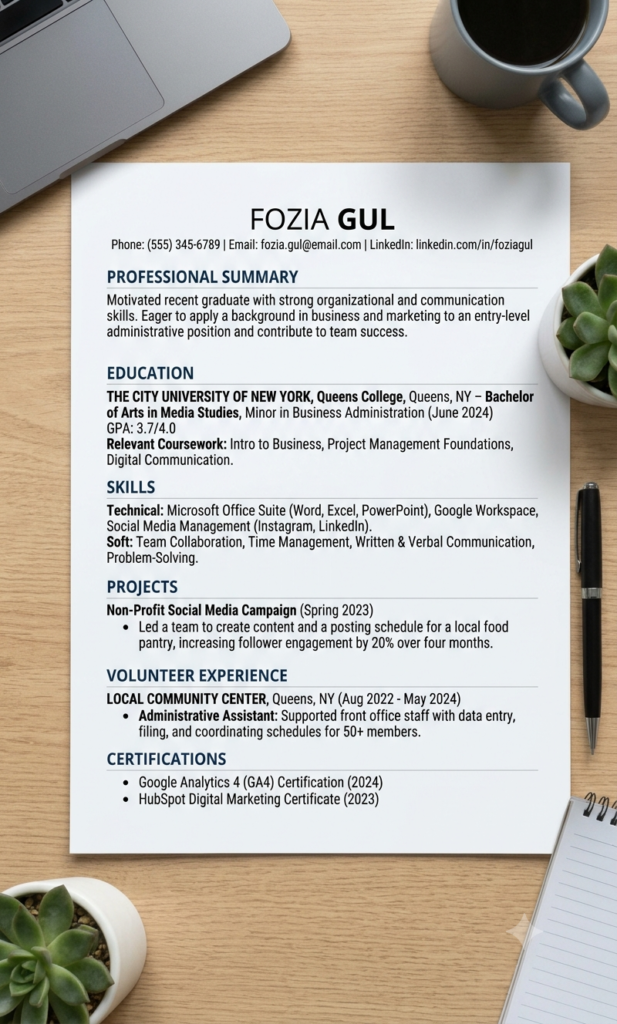
Sample CV Structure
Full Name
Phone Number
Professional Email
LinkedIn Profile
Professional Summary
A short introduction highlighting your goals, strengths, and the value you can bring to an employer.
Education
Degree
Institution
Graduation Year
Relevant Coursework
Skills
- Communication
- Microsoft Office
- Teamwork
- Problem-solving
- Time management
Projects
Website Development Project
Built a responsive website using HTML and CSS to showcase student achievements and improve user experience.
Volunteer Experience
Community Volunteer
Helped organize fundraising events, coordinated volunteers, and supported community outreach programs.
Certifications
- Google Digital Marketing Certificate
- Microsoft Excel Fundamentals
Languages
- English
- Urdu
Final Tips Before You Apply
Before sending your CV, keep these tips in mind:
- Aim for a one-page CV if you’re a beginner.
- Use a professional font like Calibri, Arial, or Times New Roman.
- Proofread carefully to eliminate spelling and grammar mistakes.
- Include numbers or measurable results whenever possible.
- Customize your CV for every application.
- Pair your CV with a personalized cover letter to make a stronger impression.
Final Thoughts
Learning how to write a curriculum vitae with no experience isn’t about trying to hide the fact that you’re new to the workforce. It’s about presenting the experience you do have in the best possible way.
Your education, projects, volunteer work, certifications, and skills all demonstrate your potential. A clear, well-organized CV shows employers that you’re prepared, motivated, and ready to take the next step in your career.
Everyone starts somewhere, and a well-written CV could be the opportunity that opens the door to your first job.
Click to view all sort of jobs here