
Ask any pre-medical student in Pakistan what keeps them up at night, and they will likely give you a two-word answer: MDCAT Chemistry.
It is completely understandable why. Chemistry makes up 45 out of the 180 total MCQs (25%) on the PMDC exam. What makes it so challenging is its split personality: one minute you are doing heavy math in Physical Chemistry, and the next you are memorizing complex reaction mechanisms in Organic Chemistry.
The most common trap students fall into is studying passively—reading textbooks over and over without testing themselves. To actually score 40+ out of 45, you need a structured, active approach. That is where practicing MDCAT Chemistry chapter wise MCQs comes in.
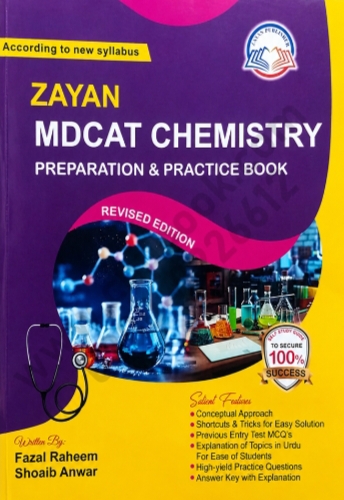
Why Chapter-Wise MCQ Practice is Your Secret Weapon
Many students make the mistake of jumping straight into Full-Length Papers (FLPs) too early. Attempting mixed-subject tests before you have mastered individual concepts is like trying to run a marathon before you have learned to walk. It only leads to frustration.
Focusing on chapter-by-chapter questions provides several distinct advantages:
- Identifies Exact Weaknesses: If you take a mixed test and get an electrochemistry question wrong, you might miss it. But if you solve 50 chapter-wise MCQs on Electrochemistry and get 15 wrong, you immediately know you need to review the Nernst equation or salt bridge concepts.
- Matches Your Academy Lectures: Whether you are studying at KIPS, STEP, Star Academy, or preparing online through platforms like Maqsad or Saeed MDCAT, your lectures are delivered chapter-by-chapter. Aligning your daily practice with your lectures cements the concepts while they are still fresh in your mind.
- Builds High-Yield Stamina: By isolating chapters, you train your brain to recognize patterns in how examiners twist questions from the exact same textbook lines.
PMDC MDCAT Chemistry Chapter Weightage & Priority
The official PMDC syllabus divides Chemistry into 20 chapters. To optimize your study hours, focus on the heaviest hitters first.
|
Study Priority |
PMDC Chapter Name |
Est. MCQs on Exam |
Core Focus Area |
|---|---|---|---|
|
High |
Atomic Structure |
~3 MCQs |
Quantum numbers, electronic configurations |
|
High |
s-Block and p-Block Elements |
~3 MCQs |
Periodic trends, group properties |
|
High |
Fundamental Principles of Organic Chemistry |
~3 MCQs |
Isomerism, functional groups, hybridization |
|
High |
Hydrocarbons |
~3 MCQs |
Benzene electrophilic substitution, alkane free radicals |
|
Medium |
Chemical Equilibrium |
~2-3 MCQs |
Le Chatelier’s principle, Kc/Kp calculations |
|
Medium |
Reaction Kinetics |
~2 MCQs |
Order of reaction, activation energy |
|
Medium |
Aldehydes and Ketones |
~2 MCQs |
Nucleophilic addition, Tollens’ & Fehling’s tests |
|
Low |
Solutions & Colligative Properties |
~2 MCQs |
Molarity, molality, Raoult’s law |
How to Approach the Three Branches of MDCAT Chemistry
You cannot study Physical Chemistry the same way you study Organic Chemistry. Each branch requires a completely different cognitive approach when practicing MCQs:
1. Physical Chemistry: Concept + Calculation
This section (Atomic Structure to Electrochemistry) is all about logic.
- The Strategy: Do not memorize reactions here. Instead, create a Formula Sheet.
- Practice Tip: Since calculators are not allowed in the MDCAT, practice rounding off values to make mental math easier. For example, treat 6.022 \times 10^{23} as simply 6 \times 10^{23} to solve stoichiometry questions faster.
2. Organic Chemistry: Reaction Patterns
Organic chemistry represents the highest concentration of repeating MCQ patterns.
- The Strategy: Master the reaction mechanisms rather than memorizing individual reactions. Focus intensely on S_N1\text{ vs. }S_N2 and E1\text{ vs. }E2 mechanisms in alkyl halides.
- Practice Tip: Create a single-page conversion map showing how to go from an alcohol to an aldehyde, to a carboxylic acid, and back.
3. Inorganic Chemistry: High-Speed Recall
Inorganic chemistry (s, p, and d-block elements) is mostly direct recall.
- The Strategy: Make comparative tables of periodic trends (ionization energy, electron affinity, atomic radii).
- Practice Tip: Since these are factual, you should be able to solve an inorganic chemistry MCQ in under 20 seconds on the real exam, saving valuable time for tough physics and chemistry calculations.
Step-by-Step Guide to Practicing MCQs Effectively
To get the absolute most out of your chapter-wise PDF practice books or online portals, try using this structured flow:
[Read Textbook Chapter] ➔ [Review Self-Made Notes] ➔ [Solve 50-100 Chapter-Wise MCQs (Timed)] ➔ [Analyze Wrong Answers] ➔ [Update Your Error Log]
💡 The Error Log Strategy: Keep a separate notebook solely for your mistakes. Whenever you get a practice MCQ wrong, do not just look at the correct key and move on. Write down the question, why your logic was flawed, and the correct chemical principle. Reviewing this personal error log 48 hours before the actual MDCAT exam is worth an extra 10–15 marks. Remember, MDCAT preparation is a marathon, not a sprint. By breaking down the massive chemistry syllabus into daily, bite-sized chapter goals and backing it up with high-quality practice, you will walk into the exam hall with complete confidence.